

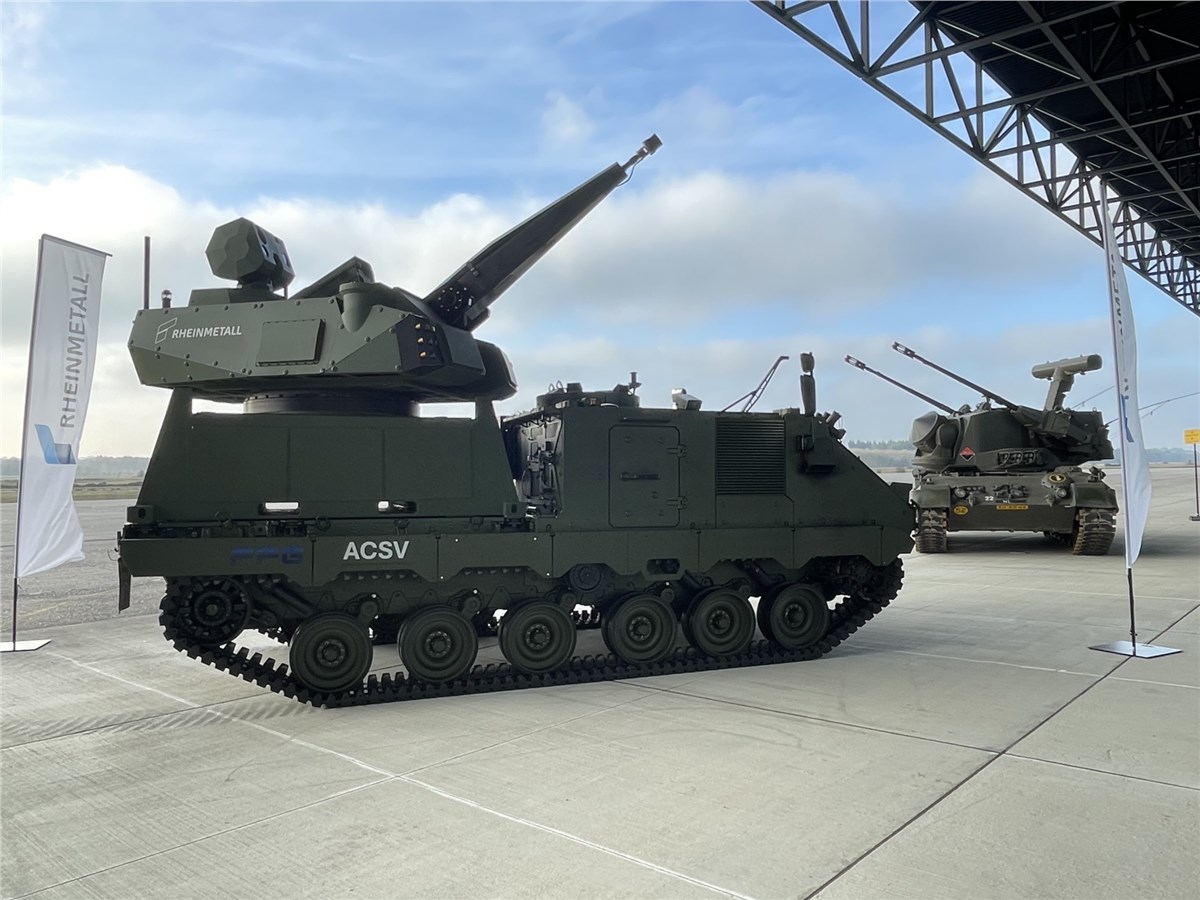
Rheinmetall has secured another significant order for mobile air defence systems. The Dutch Ministry of Defence has commissioned Rheinmetall Air Defence to supply a double-digit number of Skyranger air defence systems for the Dutch armed forces. The contract value is in the high triple-digit million euro range. First deliveries are scheduled for the end of 2028, with final delivery before the end of 2029. A substantial portion of the value added will be generated locally in the Netherlands.
The Skyranger weapon platform consists of a standard Skyranger 30 air defence turret and a lower mount, allowing mobile deployment on the customer’s armoured combat support vehicle or stationary operation from the ground. In addition to the weapon platforms, the customer has ordered tactical-level control nodes and hooklift transport platforms for purely stationary deployment. The scope of delivery also includes integration into the existing Dutch air defence architecture, classroom simulators, and a comprehensive integrated logistics support package.
The Skyranger 30 provides an ideal balance of mobility, protection, flexibility, and precision, meeting the demands of challenging close and very close-range threat scenarios. The modular hybrid turret houses a powerful 30 mm x 173 KCE revolver cannon, necessary sensors including a tracking radar, and can be equipped with additional effectors such as surface-to-air guided missiles in the future. Its high dynamics, large elevation range, and state-of-the-art sensors enable autonomous and networked operations. The system’s airburst ammunition, with programmable detonation, is particularly effective against drones.
“We are grateful for the Dutch armed forces’ confidence in our capabilities,” said Oliver Dürr, Managing Director of Rheinmetall Air Defence. “This latest order consolidates Rheinmetall’s position as the global market leader in gun-based air defence and continues the success of the Skyranger 30. The configuration for the Dutch armed forces—enabling both highly mobile operations and stationary use without a carrier vehicle—is unique to date. Another NATO country has already expressed interest in this configuration.”
